Forward-looking statements. Statements on this page regarding plans, targets, expectations, and growth strategy are forward-looking and are not guarantees of future performance. Actual results may differ due to market conditions, execution risk, regulatory changes, and other factors.
We build our advantage on process know-how, proprietary technology, and disciplined scale-up, not capital alone.
Investment Highlights
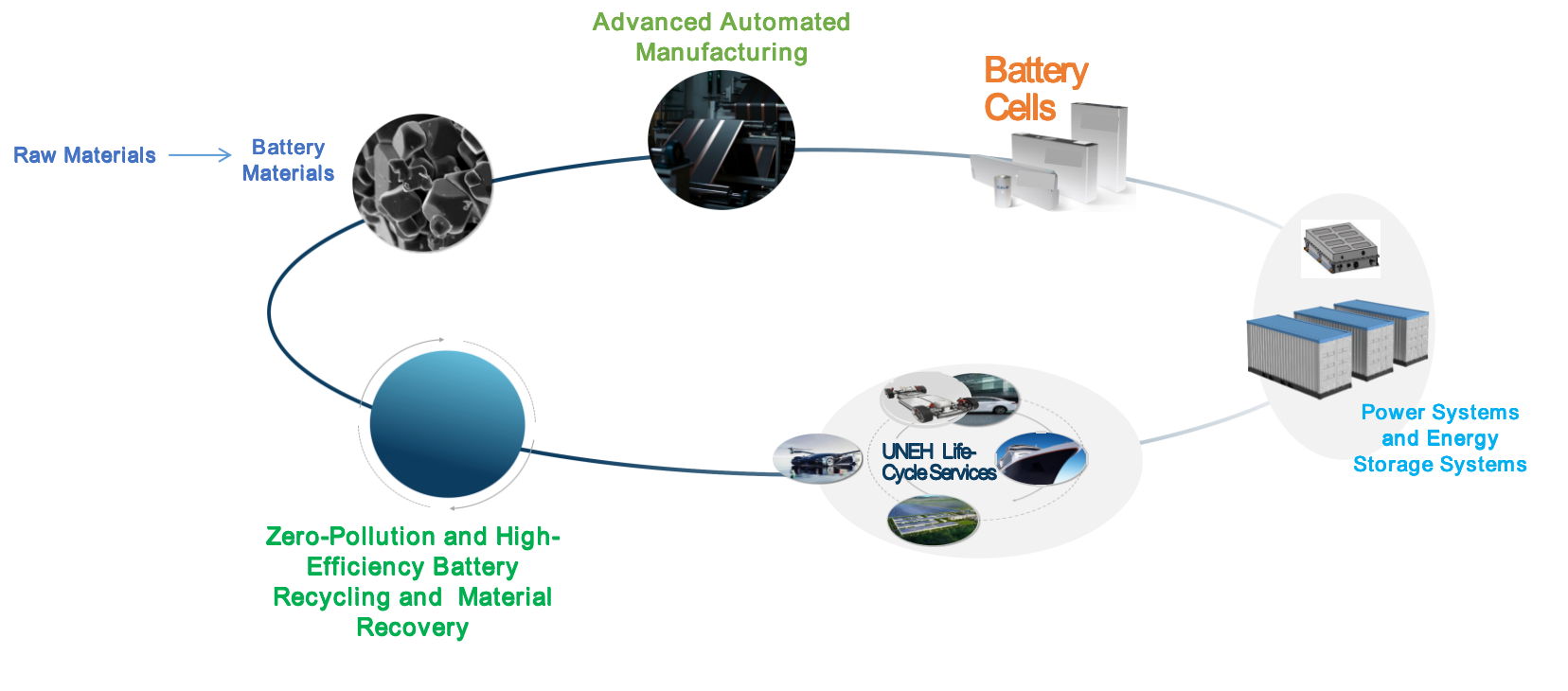
We control the full battery value chain from raw materials and components to cell manufacturing, energy storage, and zero-pollution recycling, creating a closed-loop green ecosystem.
Our recycling recovers over 95% of battery components (vs. ~30% with traditional methods). Recovered materials are reused in new production with high performance and lower manufacturing cost.
Vertical integration and advanced recycling let us deliver high-performance batteries at lower cost and secure a durable competitive advantage.
Senior leadership brings over 200 years of collective industry experience. The team has industrialized over 200,000 tons of materials and over 20 GWh in batteries and BMS.
We leverage a global network of suppliers, plant experts, and battery specialists, enabling rapid mobilization of resources and expertise, often within weeks.
We plan to establish manufacturing for raw materials, cells, systems, and recycling outside China to build local new-energy supply chains.
LFP in large-scale production with leading compaction and ≥12,000 cycles. Sodium-ion and solid-state in R&D and small-scale production. Aqueous zinc-ion validated at lab scale as a low-cost, high-performance lead-acid alternative.
Team members hold 300+ patents and trademarks in materials processing, battery and system design, BMS, recycling, and next-generation energy storage.
We plan to acquire 6 to 10 companies across materials, battery manufacturing, systems integration, recycling, and energy management, targeting combined revenue above ~$630M and profit above ~$50M by 2029.
Business Model
UNEH generates revenue at multiple points along the battery value chain. We sell battery materials (including LFP cathode, precursors, and anode) to cell makers and integrators. We also produce and sell battery products directly: commercial 280Ah and 314Ah LFP cells and semi-solid cells for high-energy applications. Recycling operations add a third stream by recovering materials from end-of-life batteries and feeding them back into production. Finally, we offer technical services and consulting to support customers with process design, scale-up, and integration. This integrated model reduces dependence on any single segment and captures value from materials through to end products and end-of-life recovery.
Growth Strategy
We pursue growth through two complementary pillars: scaling our existing operations and capabilities organically, and selectively acquiring companies that extend our reach across the battery value chain.
Organic growth
We are scaling production and commercialization of our core businesses. In battery materials, we continue to expand LFP cathode and anode output and qualify with more cell manufacturers. In battery products, we are ramping 280Ah and 314Ah LFP cells and semi-solid cells for energy storage and mobility. In recycling, we are deploying and optimizing our non-polluting, high-recovery process to close the loop and supply recycled materials back into production.
We will continue R&D into new and emerging battery technologies (including sodium-ion, solid-state, and other next-generation chemistries) to maintain our technology edge. Geographically, we are expanding beyond our current bases with localized sales, technical support, and in-region manufacturing where it makes sense. Organic growth builds on our existing technology, team, and customer relationships and keeps capital efficiency high.
M&A
We plan to acquire 6 to 10 companies by 2029 across materials, battery manufacturing, systems integration, recycling, and energy management. The goal is to add capacity, customers, and capabilities that fit our full value-chain strategy while achieving combined revenue above ~$630M and profit above ~$50M from the acquired portfolio.
Targets will be selected for strategic fit: complementary technology, geographic reach, or segment coverage. We will integrate acquired operations into our materials, products, and recycling model to create a larger, more resilient company with greater scale and diversity of revenue.
Roadmap
We are expanding commercialization of LFP and battery products, scaling semi-solid offerings, and deploying recycling capacity. Over the medium term we will scale the closed-loop model, establish localized manufacturing outside China, and pursue selective M&A to strengthen our position across the value chain.
US Roadmap
Our US entry strategy focuses initially on LFP cathode material supply, with scope to expand as market demand and capacity evolve. While US cell capacity is growing, the majority of supply today is imported. We intend to leverage our expertise in next-generation LFP materials and our track record in LFP material and cell industrialization to differentiate our offering, including through technical support to US-based manufacturers for next-generation cell production. Once a reliable domestic LFP material supply is in place, we will scale and introduce our full product set: anode materials, cells, recycling, and technical services.