
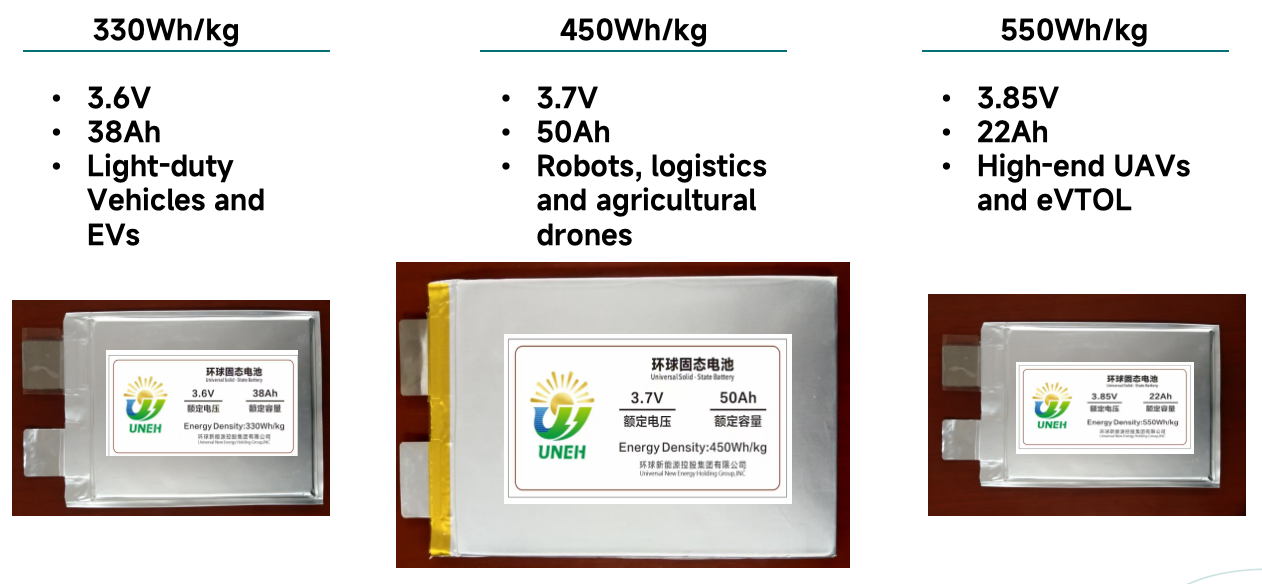
Our semi-solid technology bridges today's liquid lithium-ion batteries and future fully solid-state systems. The design combines high-capacity electrodes, solid or quasi-solid electrolytes, and interface-free manufacturing to deliver high energy density, improved safety, and scalable large-format production. We use a hybrid semi-solid route that enables stable interfaces, high ionic conductivity, and manufacturable cells without brittle, high-pressure fully solid architectures.
Core Technology Architecture
1. High-capacity electrode materials
We integrate cathode and anode systems optimized for solid and semi-solid environments. Cathode: single-crystal and reconstructed surface cathodes; single-molecular-layer surface reconstruction (0.5 to 2 nm); high reversible capacity (up to ~230 mAh/g). Anode: silicon-carbon composite anodes; high specific capacity (up to ~1600 mAh/g); structural buffering for volume expansion.
2. Interface-free battery technology
We address high interfacial impedance using interface-free formation techniques that create stable, low-resistance interfaces inside the cell, reducing impedance, improving ionic transport, suppressing side reactions, and enhancing rate capability and cycle stability without pressure-dependent interfaces.
3. Single-molecular-layer surface reconstruction
Applied to electrodes and electrolyte interfaces: functional interfacial layers at nanometer-scale thickness, stabilized electrode-electrolyte contact, prevention of interfacial degradation during cycling, and safe, fast charge/discharge behavior.
4. In-situ pore-forming technology
Closed or collapsed pores in solid-state electrodes can block ion transport. Our in-situ pore-forming technology creates continuous ion-conduction pathways during cell formation, solving ion-channel blockage, poor electrolyte penetration, and localized current hotspots.
5. 3D interpenetrating network architecture
Active materials, conductive current collectors, and solid/semi-solid electrolytes interpenetrate in three dimensions, shortening ion and electron transport paths, enhancing rate performance, improving mechanical stability, and increasing usable energy density.